systematic landscape — What onchain means here
„Onchain“ is a word that gets used loosely. This post says exactly what it means for systematic landscape, which mints on 28 October on Tezos: which bytes live in the contract, which live on IPFS, and why there is one honest footnote.
The code lives in the contract
The whole work is one HTML file: 195,087 bytes, no external dependencies, no font and no library loaded from anywhere. It reads an eight-character seed and draws the piece. This file is split into nine chunks and written into the storage of the FA2 contract. The contract also stores the SHA-256 hash of the file. Anyone can read the chunks from a public RPC node, concatenate them and check the hash. I did this independently after deployment: the bytes in the chain are byte-identical to the build. At launch the code, the loader, the price and the royalties are frozen; after that moment the contract no longer accepts changes to them.
Each token’s onchainUri is a small loader of about 3 KB, stored as a data: URI in the token metadata. It carries the seed, fetches the chunks from the chain and runs the work. No IPFS, no server. If every gateway went offline, the piece would still render from any Tezos node.
The footnote: what objkt shows
Marketplaces like objkt run tokens in a sandbox that does not allow network requests, so the onchain loader cannot execute there. Without a workaround, every token would be a still image on objkt. So after each mint a service rebuilds the work from the chunks in the chain, checks the result against the onchain hash, adds one line with the token’s seed, and pins the file on IPFS, on my own node and at a second pinning service. Both compute the same content identifier. That copy becomes the artifactUri objkt displays live.
The IPFS copy is derived; the chain stays canonical. It can be regenerated from the chain at any time and will produce the same CID. The onchain loader stays untouched under onchainUri. If you ever doubt the copy, rebuild it from the bytes in the contract.
Previews and traits
The preview image is handled the same way: a PNG at 1200 × 1600 pixels plus a 360-pixel thumbnail, rendered from the same code, pinned on IPFS. Its pointer in the token metadata can be updated by a dedicated operator key, so a better preview later does not need a new token. Eight traits are read from the seed and written into the metadata: palette, pairing, binding, grids, structure, light cuts, seam, bridges. They describe the drawing; they never decide it.
Why this effort for 128 pieces
Because the sign systems in the work are about reliability without an author. A piece that depends on my server, or on a file somebody has to keep hosting, would contradict its own subject. The chain holds the work; everything else is a convenience that can be rebuilt from it.
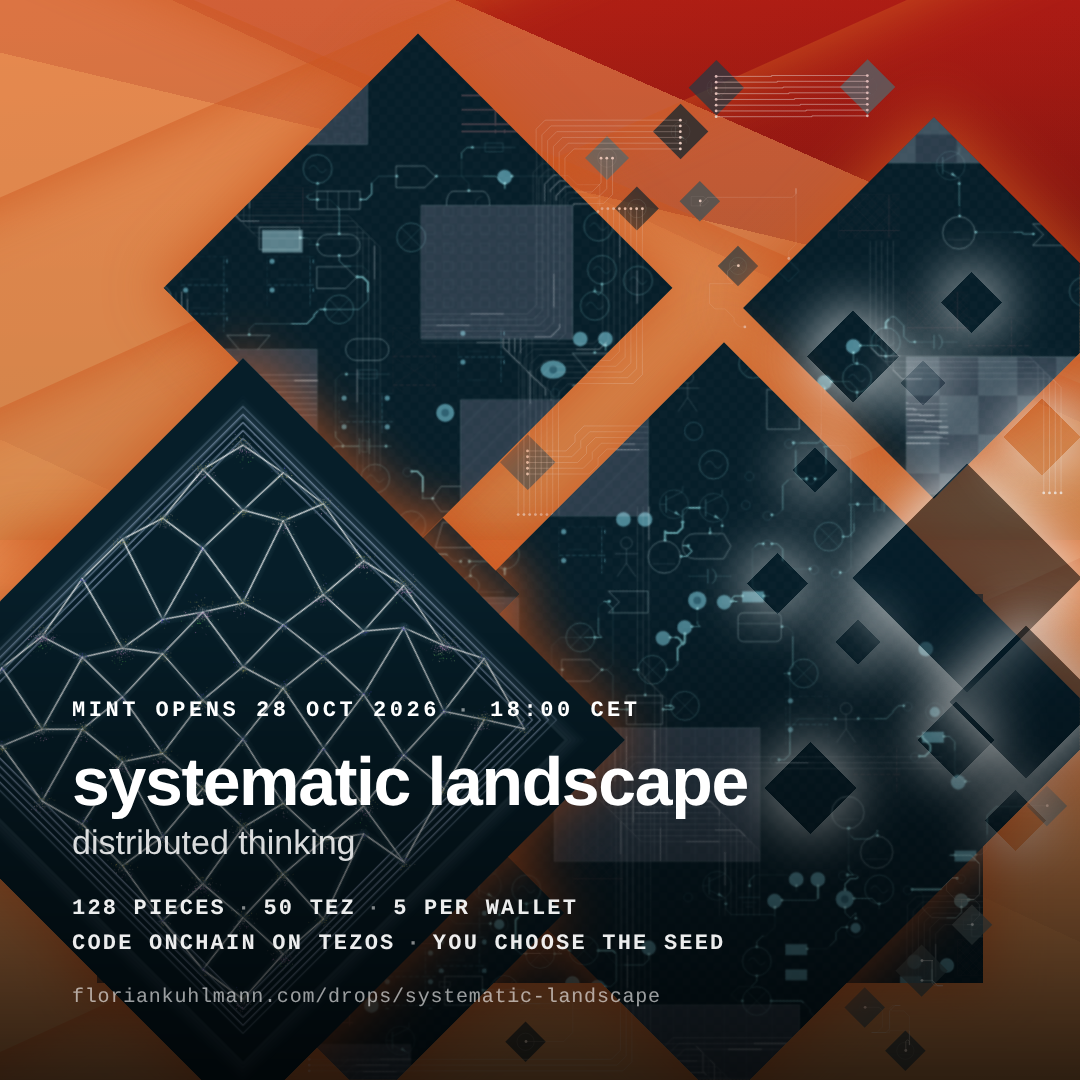
Mint opens Wednesday, 28 October 2026, 18:00 CET. 128 pieces, 50 tez, up to five per wallet. → floriankuhlmann.com/drops/systematic-landscape · Contract: KT1Xtuz8HJ4agyRtDWKnVfzN4vTowCWGnwi9